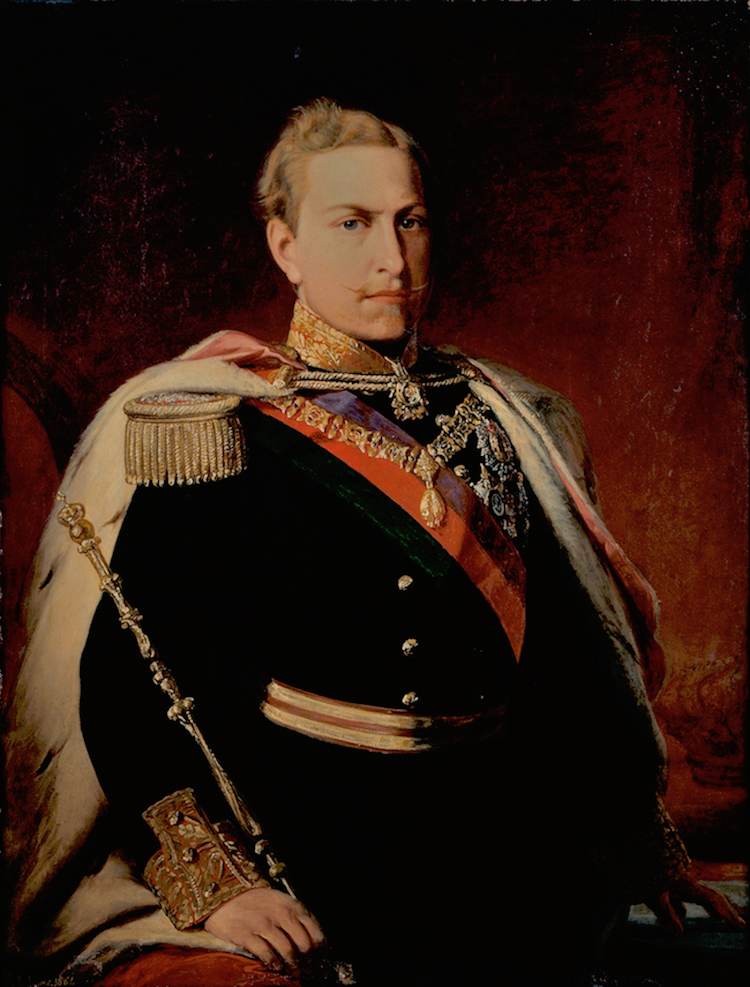
Retrato do Rei D. Luís I
Autor: Carlos António Rodrigues dos Reis
Centro de Fabrico: Portugal (?)
Data: 1864
Material: Óleo sobre tela
Dimensões (cm): Larg. 99,5; alt. 123,4
Proprietário: Museu de Aveiro
N.º de Inventário: 18-A


King Luís (1838-1889) was one of the emblematic individuals of the House of Bragança that – in 1640 – became the 4th Portuguese dynasty. He was the second son of Queen Maria II and Fernando II, and ascended to the throne after the death of his brother Pedro V.
He was born in Lisbon and lived with his parents and his six siblings. His education was strict and he dedicated much of his time to studying. He had a great artistic sensitivity – he painted, composed and played the cello and piano. His love of literature led him to translate French and English pieces into Portuguese – his translations of Shakespeare are renown. But Luís was primarily a man of science, with a great passion for oceanography. His time in the Navy – when he travelled throughout the kingdom and Europe – contributed to his better understanding of life and the world.
As a man of liberal convictions, his reign was marked by august moments such as the abolition of the death penalty and of slavery. He was also responsible for the first Portuguese Civil Code. His rule was relatively calm, with peace and progress. The stance he maintained throughout his reign reflected his personality – moderate and tolerant – respecting public liberties and defending the integrity of the kingdom.
Luís’s reign was also marked by actions to promote public utilities – expansion of the road network, development of the Leixões port, construction of metal bridges over the Douro River. Several publication of literary pieces took place and newspapers were developed, such as the Diário de Notícias, Jornal de Notícias, O Primeiro de Janeiro, O Século and the Ilustração Portuguesa. There were also several technical and scientific advances – through economic initiatives (i.e. Porto International Exhibition), measures that contributed to the moral progress of the country, the foundation of the Republican Party and through the stimulus of expeditions in territories of the African continent, especially between Angola and Mozambique.
Luís died at the age of 51 and is buried in the Royal Pantheon of the Bragança, in the Monastery of São Vicente de Fora (Lisboa).