
Publius Decius Mus Series: Publius Decius Mus is consecrated before facing Death
Author: Jan Raes II (master weaver) & Peter Paul Rubens (cartoonist)
Origin: Brussels, Flanders
Dating: 1618-1643
Material: Wool & Silk
Dimensions (cm): 405 x 415
Inv. no.: PD0405

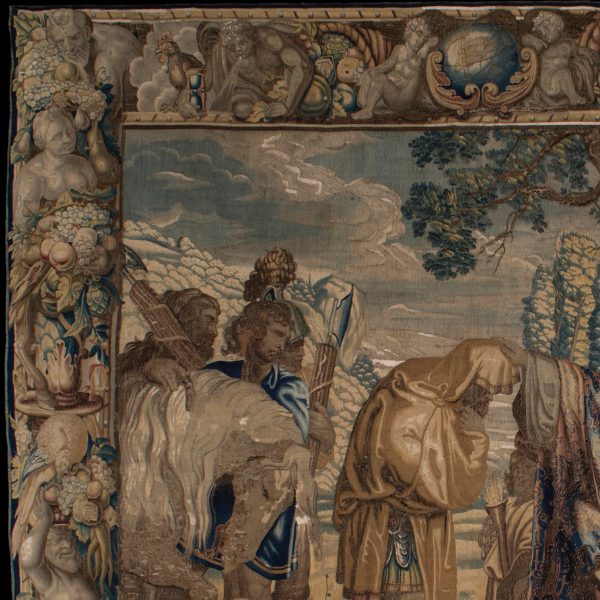


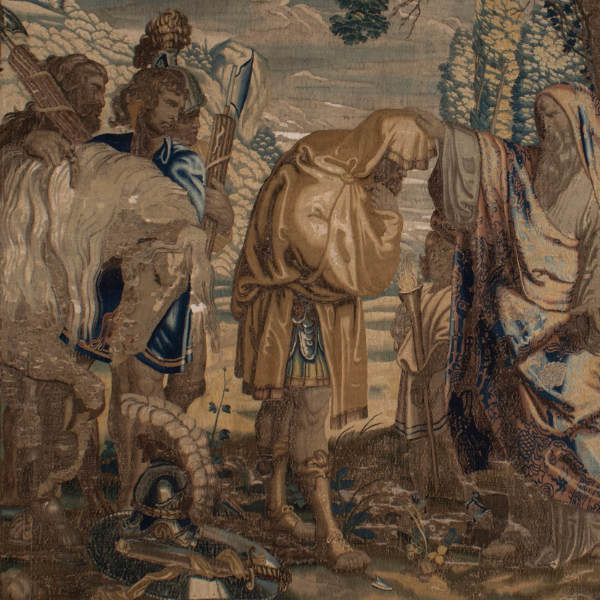

Decius Mus – after hearing his fate pronounced by the Roman High Priest – receives the last rites and recites the Death prayer: “Janus, Jupiter, Father Mars, ye household gods, ye newly adopted gods, ye gods of Rome, ye heavenly ones under whose power we and the enemy stand, and ye gods of the dead, I beg and implore ye: give the people of the city of Rome superior might and victory, but unleash fear, havoc and death on their enemies. As I have expressly promised here, on behalf of the state of Rome, the army and its legions, I now commend the legions of the enemy and myself to the gods of death and to the earth, as sacrifice”.
As was the custom, Decius Mus has his feet resting on top of an arrow and receives the blessing from the High Priest, dressed with an enormous red toga covering his head, highlighting the devoted tilting of his body. The brocaded mantle of the Priest, embroidered in gold and shining in the light, emphasises the solemnity of the scene.
Incidentally, in his representation of the quality of the materials, Rubens used an old Dutch tradition. The poses of the other characters involved in the scene relate to the two main figures: a witness wrapped in his mantle accompanies the Priest, while two soldiers, on the right, bring the Commander’s horse. The horse tilts its head, repeating Decius Mus’ gesture.
Publius Decius Mus
He was a Roman politician who belonged to the gens Decia (a plebeian family renowned in Roman history for the sacrifices made by its members for the preservation of their country).
Publius Decius Mus is first mentioned in 352 BC, when he was appointed as one of the quinqueviri mensarii (public bankers), who were tasked with alleviating the debts of citizens, to a certain extent.
In 343 BC, he served as a Military Tribune (a Roman Legionary officer) under the command of the consul Marcus Valerius Corvus Arvina during the First Samnite War. Due to his heroism, at the Battle of Satricum, he saved the Roman army from imminent danger.
In 340 BC, he was elected consul, together with Titus Manlius Imperiosus Torquatus. In that year, the Second Latin War began (340-388 BC), during which the Battle of Vesuvius took place – fought between Naples and the Mount Vesuvius – commanded by the two consuls.
During this battle, Publius Decius Mus became renowned for his legendary devotio, in which he vowed to sacrifice his own life in exchange for victory. According to Titus Livius, Decius Mus had a prophetic dream, foretelling that the army whose general died in battle would be victorious. The devotio (an extreme form of votum, a vow made to a deity), was a Roman ritual, and the most famous example is associated with Publius Decius Mus. The practice is also found in Greek legends.
“Flora in the Palace’s Collections”
«The intrinsic qualities and virtues attributed to each fruit – throughout the Middle Ages and Renaissance – underwent constant changes influenced […] by the contemporary interpretations of sacred and philosophical texts, which either reevaluated or reiterated the information established by classical Antiquity authors. Generally, during these ages, the prevailing medical belief was that fresh fruits should be consumed with caution, for they were categorized as cold and dangerous foods, despite their potential to stimulate appetite.
However, in the courtly environments of the Renaissance table, fruits came to occupy an important place in the preparation of meals, pertaining the stimulation of taste and smell. With increasingly refined presentations, they were intended to adorn sumptuous tables and, occasionally, were also used as palate cleansers between cooked dishes.
Gradually – from the late 16th century onwards – fruits began to play an increasingly significant role in the grand stage of pictorial representations of specimens, with a growing emphasis on the originality of their forms and varieties and a heightened observation and interpretation of the earth’s bountiful gifts.
Within this world of representation – in the wake of the Italian trend – a production of Flemish paintings arose – consisting on representations of market scenes with an abundance of edible goods from a vast array of species. Alongside traditionally consumed fruits, newly imported ones appeared in subsequent still-life paintings, along with flowers, tiny animals and carefully selected artifacts of glass, metal or porcelain. However, fruits stood out due to the sensuality of their organic nature, to their presentation enhanced by colour – conveying imagined scents and flavours, inviting the viewer to imagine their touch and taste, in contrast to the other represented elements.
The Publius Decius Mus series […] was woven in the first half of the 17th century, under the patronage of Archdukes Albert VII of Austria and Isabella Clara Eugenia – daughter of Felipe II of Spain – who established their court in Brussels, welcoming […] some of the most important artists of their time, among them Peter Paul Rubens – appointed as the court’s official painter in 1609 – who was the author of the cartoons for this series of tapestries (BAUMSTARK,1985).
Jan II Raes (ca 1570-1643), who belonged to one of the most prestigious tapestry-making dynasties in Brussels, would have been a natural choice for such an important commission. [He was the] Master of a workshop that likely employed around one hundred and fifty artisans – he would have the requisite quality and inventiveness to reproduce, with rigor, the cartoons that Rubens had executed for the commission of the Publius Decius Mus series.
Regarding the borders of the tapestries, the weavers were free to choose and adapt local design patterns that had been traditionally used in the workshops. The elaborate variety of fruits and vegetables, in baskets, with the symbolic elements of the passage of time, the terrestrial globe, the wind and Mercury, the aquatic realm of the nereids, satyrs, goats and adorned oxen, parrots and mascarons, were part of a vocabulary present in other tapestries from the workshop of Jan II Raes.
The dazzling variety of pomes depicted – and the vegetal counterpoint between species familiar to Europe and others more recent from the American continent – are not only part of the borders of the tapestries in the collection of the Ducal Palace, but also of other exemplars from the same workshop that depicted the same theme, in collections in Prague, Hamburg and in the Principality of Liechtenstein.
Corn, cocoa and pumpkins of the Cucurbita genus were part of the fascination with exotic and rare foodstuffs since the early 16th century. Described, first-hand, in a very rigorous manner, by Gonzalo Fernández de Oviedo – a chronicler of the Spanish presence in the Americas – the interest in their representation would have spread first in Flanders, where the chronicler landed, in 1516, upon returning from his first voyage to the American continent and where he would have shown drawings of the species.
In the representation of the fruits and vegetables in the Publius Decius tapestries, the details that migrate schematically from one plant to another are particularly interesting, as in the case of the cucurbitas (pumpkins) that resemble cabbages, as represented in several 16th-century paintings. In addition, regarding gourds, we could be looking at Lagenaria – which arrived in Europe via Africa and has a history of domestication of thousands of years – or at one of the many forms of Cucurbita pepo – hat began to be common in the 16th century and had just arrived from the American continent.
Given the elaborate ornamentation of the borders – and the Baroque profusion of fruits, vegetables and cereal entangled with one another – it is not possible to draw conclusions on the symbolic elements that would lead to understanding the preference for one over the other. The choice focuses on the contemporary grandiose language that echoes the multiple cornucopias of Antiquity.
The various species of Prunus, apples, pears and grapes, parsnips and turnips, vegetables, asparagus and artichokes, cereal, and of all the new products coming from the American continent, as well as of the noble fruits – olives, lemons and pomegranates, imported from Spain and Portugal (GUICCIARDINI, 1613 [1567]) – had, at the time, a practical dimension of consumption, through their physical effects on the diet, hence deriving a possible interpretation that relates them both to the ostentatious pleasures of the flesh and to the antidotes for these excesses. However, grapes, apples and pomegranates persist in probable conformity with their constant symbolic interpretation which, since the dawn of their extensive narrative, have always stood out in representations of the Christian world.
Despite being an era with new windows opening up to the world – where paradisaical images of lands to be explored converged and from where the vertiginous arrival of fauna and flora expanded the imagination of Europeans – the reality in which both the painter Rubens and the tapestry weaver Jan II Raes lived and worked, would be better described as an era immersed in the despair of the tragic conflagrations between Protestants and Catholics. The commission that Rubens received from the Genoese merchant Franco Cattaneo to represent episodes from the life of the Roman consul Publius Decius Mus could not fail to interest him, given that its content and moral example were extremely edifying for the times. According to what he wrote, Rubens admired “the Roman consul who sacrificed himself for the victory of all Romans” (HERRERO CARRETERO, 2007) and, although exalting the feats of the hero that Titus Livius illustrated in his History (TITUS LIVIUS, 1853), the narrative of the representation – through the tapestries – focuses on the stoic morality and altruism of the Roman consul’s sacrifice.
However, the Latin motto at the bottom of each tapestry has nothing to do with the deeds of Publius Decius Mus. Ars et vis divina superant omnia is part of the harmonious whole of the border design, as seen in the series […] The story of Samson from the workshop of. “Art and divine force overcome all” was the weaver’s motto, to which, in his late age, he proudly added and reinforced with the signature Jan Raes.»
Sasha Assis Lima
