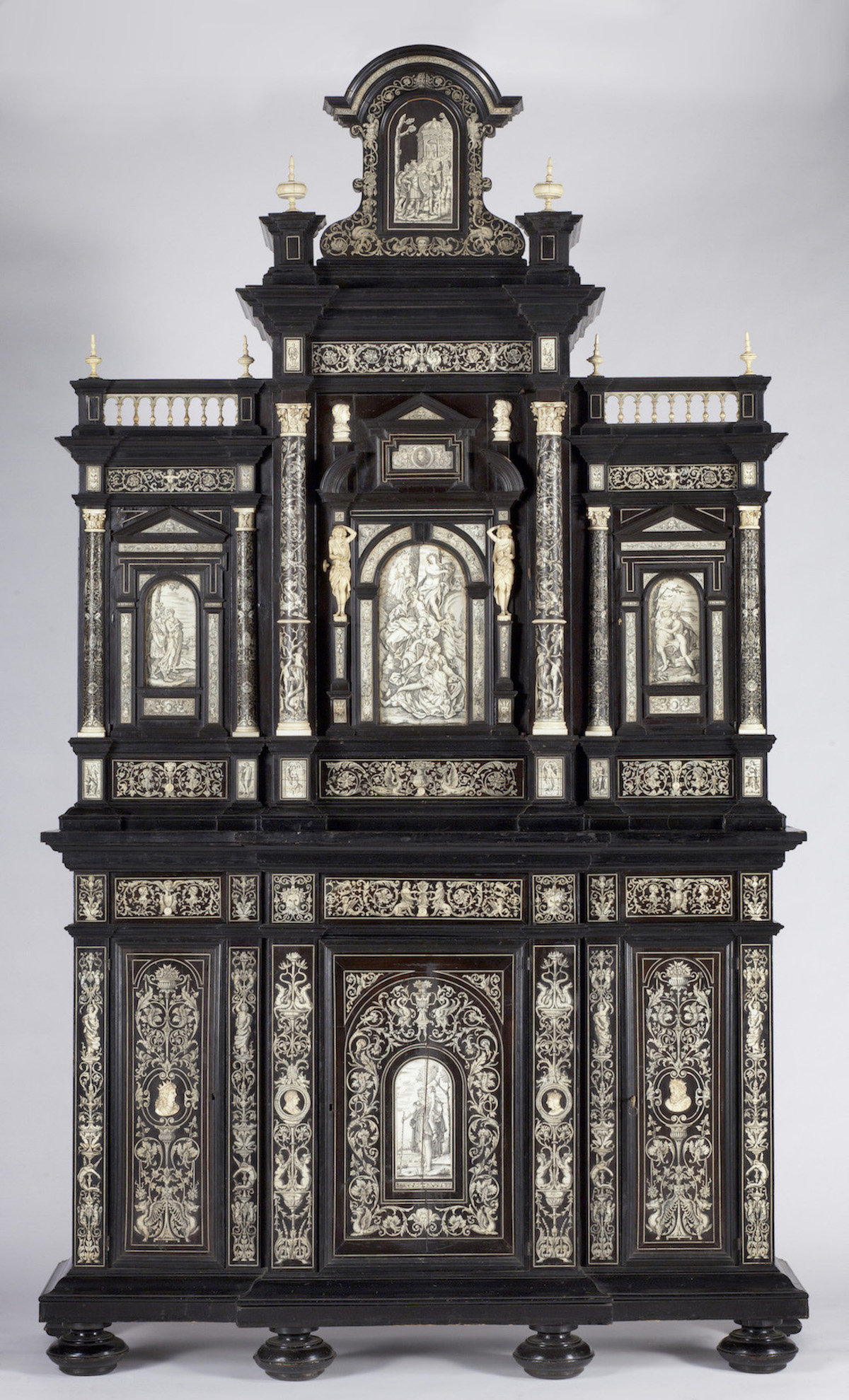
Cabinet
Author: Unknown
Origin: Unknown
Dating: 17th century
Material: Wood & Ivory
Dimensions (cm): 274 x 156,5 x 51
Inv. no.: PD0297



“Music in the Palace’s Collections”
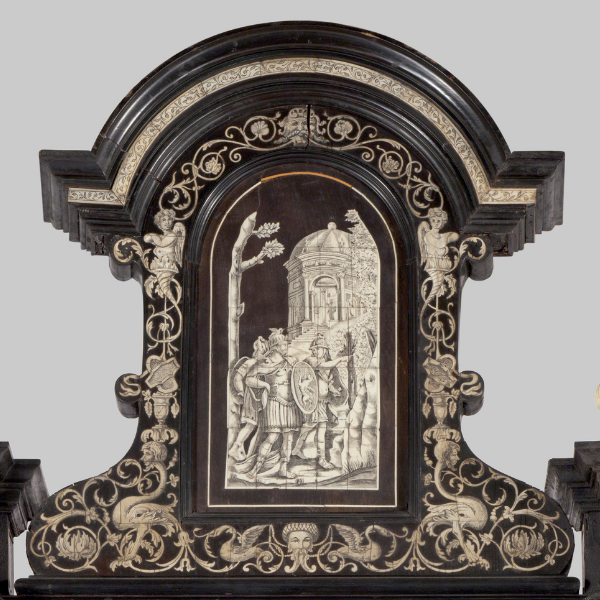
«This cabinet is divided into three registers […]. Each register has a frieze above or at its base. The register in the middle is divided into three niches, while the upper and lower registers have only one. The decorative theme of the whole ensemble is Hellenic mythology.
The cabinet’s middle area’s centre displays an image of Apollo and the Arts, represented by some muses. Apollo holds his Lyre – in an inverted and stylized position, which does not allow for an organological description. Another muse holds what seems to be either a highly stylized Portative Organ (Polyhymnia?) or a kind of Harp, representing – being that the instrument – Terpsichore, the muse of Dance. Above her, one may see the back of a stringed instrument – a type of Guitar – representing […] Clio, the patroness of History. Two other muses are identifiable: in the lower area, with her back turned, holding the instrument as a Trumpet, there is Calliope – muse of epic poetry and eloquence – and Thalia – the muse of Comedy – who is holding a mask, facing […] Calliope.
The position of Apollo suggests the same god from the work of the French Baroque artist Simon Vouet (1590‐1649), entitled Parnassus or Apollo and the Muses.
In addition to Apollo and the Arts – in the frieze that depicts this register, in the penultimate (to the right) of the six small rectangles that decorate it – one may see a female figure with a Lyre (in the correct position) in her left hand, which can be identified as the muse Erato – the muse of Lyric Poetry. Usually, Erato is represented with a violin bow in her right hand. In this depiction a bow appears – fallen – but with the configuration of a hunting bow. The function of these instruments serves merely to identify the figures that hold them.
[…]
The vielle […] is represented in the fifth small rectangle that decorates the frieze above the balustrade that separates the lower register from the one in the middle […]. The vielle represented in the figure – as well as the “bow” that rubs against the strings – are highly stylized, making it difficult to give a better organological description. However, the configuration of the instrument refers to the beginning of the construction of these instruments in Italy. On the other hand, the bow in the figure only evokes the condition of the vielle’s friction strings. In another context, its shape would point to any [unrelated] small stick.
The depiction is quite undefined in terms of gender. However, its interpretation in the likes of the main subject of the ornamentation – and disregarding the musical instrument – it could be identified as one of the muses – Thalia – taking as ivy the representation of long hair and considering the boots shaped as a mask. Therefore, as music is intrinsic to theatrical representation, it is in this basis that the vielle […] is seen.»
Eduardo Magalhães