
Cabinet
Author: Unknown
Origin: Unknown
Dating: 18th century (?)
Material: Wood
Dimensions (cm): 216 x 207,5 x 58
Inv. no.: PD0298


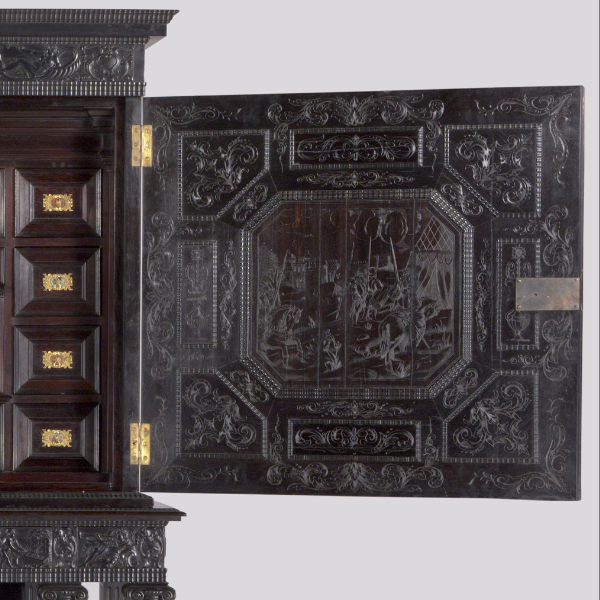



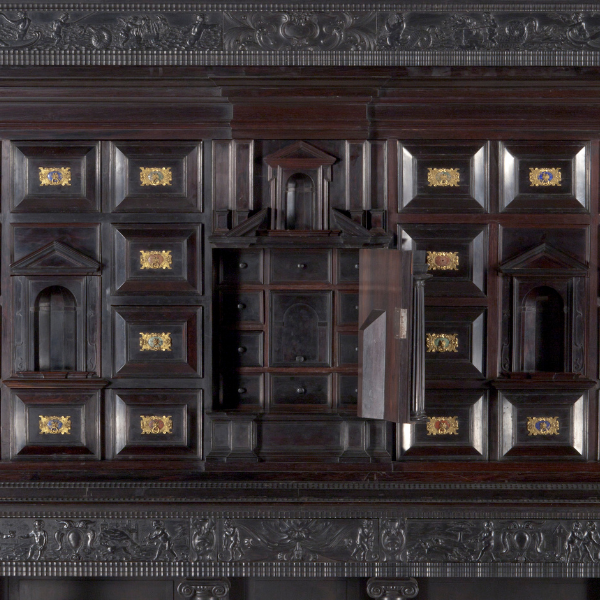


«This cabinet is composed of two bodies, with the upper one having drawers in the front (enclosed by two doors) and the lower body, shaped as a table, which in turn rests on twelve columns – six at the back and six at the front. Four of the columns in the rear […] are connected, composing an extension of the Cabinet’s rear.
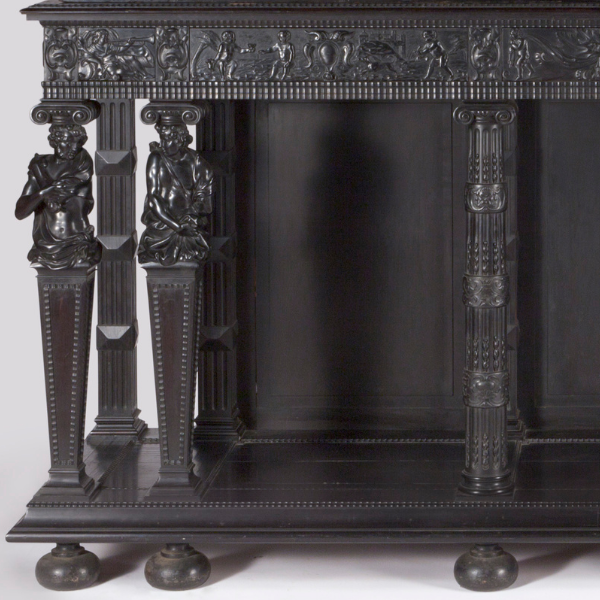
Of the six columns at the front – two on each side – the upper half displays two male figures, half-length, facing each other. Each of the central columns – levelled with the figures on the ends – display a bearded head with horns on the forehead. The columns were carved in the style of Ionic columns.
The decoration of the Cabinet is of a very creative wood carving style, in high and low relief. […] [The] artistic inspiration drew on Greek mythology […].»
Eduardo Magalhães
“Music in the Palace’s Collections”
«In the centre of the balustrade’s frieze – on which the upper part of the Cabinet rests – four different scenes involving putti may be seen, flanked at the ends by two figures playing a horn.
In one of these scenes, there is a putto, holding a small metal horn in his left hand and a spear in his right hand. The figure – in the vicinity of a castle – is in a running position, behind his dog, both chasing the hunt. The horn, although curved, due to its small dimensions, does not curl in a circle – [thus,] being more similar to the primitive instrument made of animal’s horns. In this case, naturally, its function is to prompt both the hunter and the hunt itself.
[…]
The scene in which the drum is depicted is of military nature – possibly depicting the siege of a city or castle, considering the image in the background. The drum’s shell is sizeable – in relation to both membranes – which allows for a voluminous sound […]. The position of the instrument in relation to the musician seems inverted, since it was normally carried on the left side and played with the right hand. The same inversion may be observed in the sword of the soldier by his side. This inversion may have resulted from the fact that the scene is engraved in bas-relief, on the inside of the Cabinet’s right door.
In one of the well-known paintings by the Dutch painter Rembrandt van Rijn, the drum appears to signal the passage of the night watch on patrol. In the center of the frieze of the balustrade on which the upper body of the Counter rests, four different scenes can be seen represented by putti, flanked at the ends by two figures playing a folded trumpet.
In one of the scenes, there is a putto, wielding a small metal trumpet in his left hand and holding a spear in his right hand. The figure, in the vicinity of a castle, is in a running position, behind his dog, both chasing the hunt. The trumpet, although curved, does not curl in a circle due to its small size, more similar to the primitive animal horn trumpets. Here, naturally, its function is to signal both the hunter and the hunt itself.
[…]
The scene in which the drum appears is of a military environment, possibly depicting the siege of a city or castle, considering the image in the background of the plane. The cylindrical shaft is large in relation to the two membranes, which allows for a voluminous sound box resulting in a corresponding sound volume. The position of the instrument in relation to the musician seems inverted, since it was normally carried on the left side and played with the right hand. The same inversion can be observed in the sword of the soldier by his side. This inversion may have resulted from the fact that the scene is engraved in bas-relief, on the inside of the right door of the counter.
In one of the well-known paintings by the Dutch painter Rembrandt van Rijn, the drum appears with the function of signalling the passage of the night watch on patrol. Like the instrument on the Cabinet, it is a drum of large proportions that granted potent sound.»
Eduardo Magalhães
