
Mirror
Author: Unknown
Origin: Unknown
Dating: 18th century
Material: Wood & Glass
Dimensions (cm): 172 x 81,5
Inv. no.: PD0413
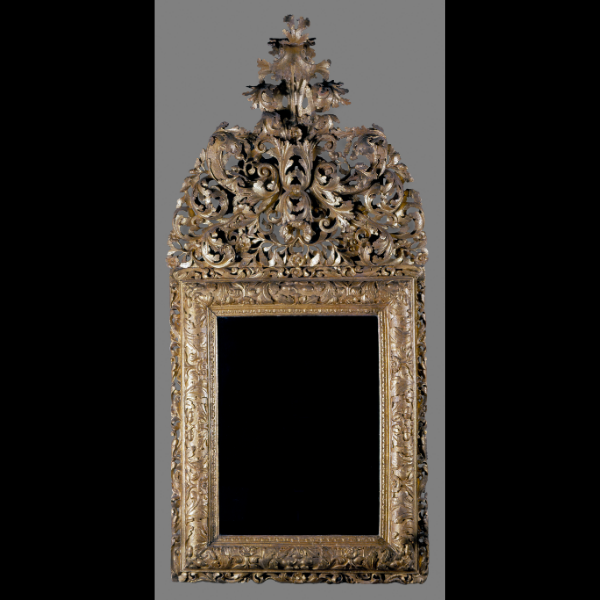


A mirror with a gilded carved frame. The upper part displays acanthus leaves and flower motifs and, the lower part, acanthus leaves, flowers and acorns.
Mirrors date back to 6000 BC, when inhabitants of Anatolia (part of modern-day Turkey) began polishing sheets of volcanic rock. From 4000 to 3000 BC, people from Mesopotamia (present-day Iraq) and Egypt used polished copper plates. In China, around a thousand years later, bronze was used.
The first glass mirrors were created by artisans in Venice (Italy) in the early 14th century. Their reflective layer consisted of a mixture of tin and mercury.
In 1835, the German chemist Justus von Liebig developed a method of applying a thin layer of metallic silver to the glass, giving way to modern mirrors. This new technique – which was safer, simpler and cheaper – popularised the use of mirrors throughout the world.
