
Lectern
Author: Unknown
Origin: Unknown
Dating: 16th century
Material: Iron
Dimensions (cm): 50,3 x 56 x 70,5
Inv. no.: PD0350



«The concept of angels can be traced back to the Persian civilization, more specifically to Zoroastrianism, founded by Zarathustra […]. At the core of this religion, there were two opposing divinities that can be “translated” into the Christian principle of good (god – Ahura Mazda) and evil (devil – Angra Mainyu). To protect humans and guide them towards good, this religion conceived a series of superior beings, each corresponding to what we could call virtues or moral concepts, whom one could call upon to avoid falling into evil. This concept of protective spirits was assimilated by the Jews – who were captives in Babylon – and transmitted to the Christians when Christianity developed on the basis of Judaism. Neighbouring countries were also influenced by this Persian culture, as was the case with Greece. The iconographic representation of these winged beings may have been conceived from the Greek mythological figure, the goddess of victory – Nike – who was initially asexual and later masculinized.
[…]
Hermes – the Greek god – da mitologia grega, transformed into Mercury in Roman assimilation, was a multifunctional deity, possessing various attributes among which were magical winged sandals for faster movement. To Mercury, Jupiter added two wings to his helmet to achieve greater speed. This association of wings with messengers may date back to the use of carrier pigeons, evidenced from 6,500 BC onwards (MAGALHÃES, 2018: 172).
The first to theorize about angels was Dionysius – known as the Areopagite – who claimed to have been converted and a disciple of St. Paul. He wrote several texts and, in one of them – De coelesti hierarchia – presented in 15 chapters, he developed a description of the celestial hierarchy where he presents the angelic entities that mediated between divinity and humans.
He grouped each of the orders he mentioned according to specific functions. This Dionysius – whom the Church celebrates as a saint on October 3rd – would later be questioned in terms of his historical authenticity, eventually becoming known in the 19th century as Pseudo-Dionysius. Nevertheless, his texts were accepted as unquestionable truths throughout the Middle Ages. Until the 16th century, they were considered apostolic texts, therefore indisputable (MAGALHÃES, 2018: 173).
In the 12th century, the monk Bartholomaeus Anglicus, upon this concept of Dionysius, wrote De Proprietatibus Rerum (On the Property of Things), a work translated into Spanish in 1494, and subdivided into several books. In the introduction to Book II, “which deals with good and evil angels and their properties“, the author presents an image with the three celestial orders, in groups of four angels for each level. The last one, which includes the angels, is presented with each of them playing a musical instrument: lute, rebab, trumpet & flute (?) and drum […].»
Eduardo Magalhães
“Music in the Palace’s Collections”
«Although not listed among the indispensable objects on an altar, the lectern is almost an obligatory utensil for placing the books of the different rites officiated there. The primitive altar of the early Christians was a portable wooden table, due to persecutions. After the 4th century, it began to be made of stone and fixed to the floor and since the 12th century this fixed type of altar has been mandatory (JUNGMANN, 1962: 63). These books for the officiant’s service are even called altar books, somewhat in opposition to choir books, the books for the singers.
[…]
Although lecterns não fossem were not considered intrinsic objects to the rituals, they were, nevertheless, extremely practical for placing the necessary books. While those for choir books – due to their size and the inconvenience of constantly moving them – remained in the most appropriate place for their use, altar lecterns could easily be removed and stored. Those used for choirs were larger, with a high base, some of them in the shape of a triangular pyramid and, often, rotatable. This allowed for the support of two books at the same time, one for each side of the choir in the Office, for example, or different ones, if the ritual required it.
[…]
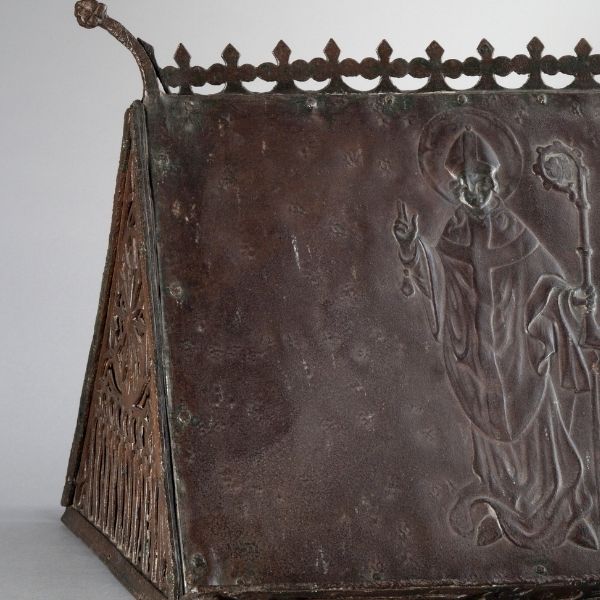
Because of the respect they conferred on the books they supported, lecterns were often the subject of rich and creative decorations, whether they were wooden or metal lecterns, as is the case with this particular lectern or stand. It has the shape of a triangular prism, allowing for the placement of two books resting on its inclined planes, on the ledges it has at the base to aid in support.
This altar lectern […] is decorated on both of its planes: on one, there is the figure of a saint in episcopal vestments, standing, with a crozier in his left hand and his right hand in a blessing position. On the opposite plane, three angels are depicted on clouds. The angel on the left holds a phylactery where one may read the words – although quite faded – Ave Maria. The angel in the middle, with folded hands, is in an stance of prayer. The angel on the right plays a trumpet, an instrument that announces, in this case, the word of God kept in the sacred books that the lectern supports and (it may be understood) represented in the posture of the central angel.
The angels playing trumpet are found in the Book of Revelation of St. John when the apostle describes the destruction of the world. The apostle enumerates seven angels, each with their own trumpet, giving rise to the gradual destruction of the Earth as each one, in turn, sounds their trumpet. (BÍBLIA: pp. 1618‐1622) This Christian text underpins an entire iconography of trumpet-playing angels that art would come to develop in multiple contexts.»
Eduardo Magalhães
