
The Parable of the Ten Virgins
Author: Unknown
Origin: Unknown
Dating: 17th century (?)
Material: Oil on Canvas
Dimensions (cm): 91,2 x 121,7
Inv. no.: PDdep0020

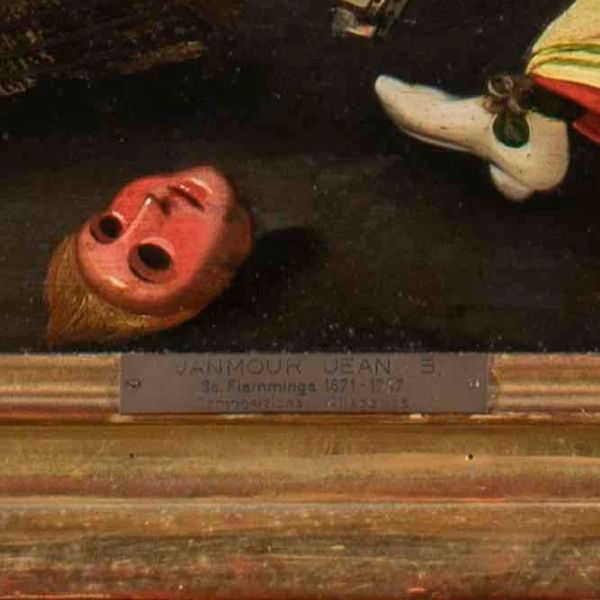


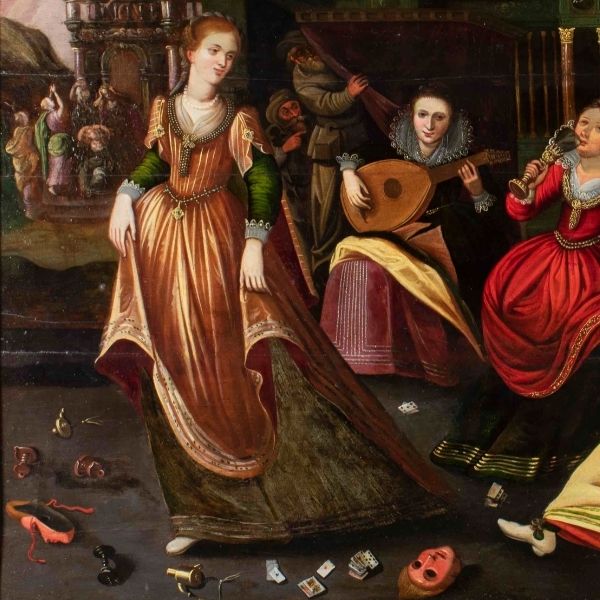


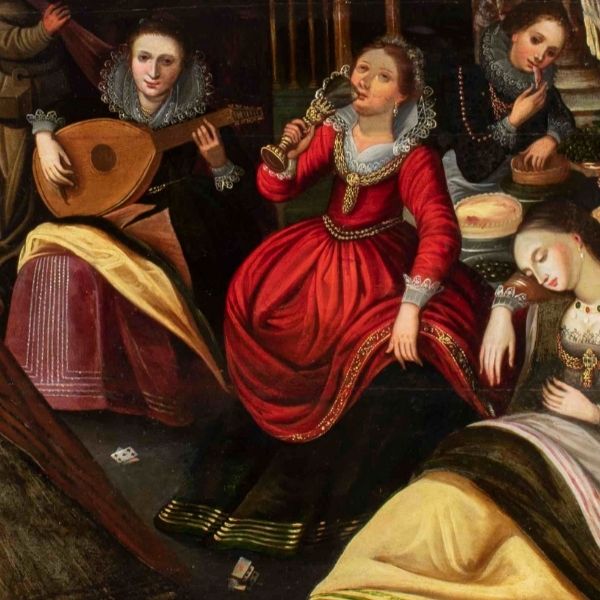


«This painting depicts the parable of the ten virgins, as narrated in the 25th chapter of the Gospel of Matthew. According to this evangelist, Christ compared the Kingdom of Heaven to ten virgins who went out to meet their grooms. Five of them, whom he labelled as “foolish”, went without oil to feed their lamps, while the other five, the “wise”, took it. As if the groom was delayed, they all fell asleep until the groom arrived. When he did, the wise ones went to him with their lamps properly lit and entered the wedding hall. The “foolish” ones, with their lamps unlit, were denied entry. This scene is represented in the background of the painting, on each side.
In the main area of the painting, one may see the “foolish” in the midst of revelry, possibly representing some of the seven deadly sins in Christian religion: pride, in the standing figure; sloth, in the figure sleeping at the table; gluttony, in the figures drinking and eating, one on each side of the table; lust can be represented by the central figure playing a lute, an instrument also associated with seduction. The cards and masks on the floor (in addition to the abandoned lamps) complement this interpretation. OThe two old men, behind the curtain, may represent those who come to warn of the groom’s arrival.
On the table, a peacock can be seen with its tail fully displayed. Due to their annual moulting, Christianity associated these birds with resurrection, and thus with Christ. The many eyes adorning the tail allow for an association with a watchful presence over the “foolish” virgins.»
Eduardo Magalhães
“Music in the Palace’s Collections”
«Lutes are musical instruments classified as “low-pitched”, meaning they are suitable for indoor playing. It was the principal instrument in chamber music during the Late Middle Ages and the Renaissance, eventually giving way to the harpsichord in the early 17th century.
Lute is of Arabic origin and literally means “wood”. […] [I]ts introduction to the West is thought to have been through the Crusaders. Its configuration differs from the guitar in that it does not have an eight-shaped soundbox, but an oval one, its neck ends at a right angle where the tuning pegs are fixed, and its soundboard is pear-shaped.
Here, the lute, as it is also associated with an instrument of seduction, represents the vice of lust, played by one of the five “foolish” virgins. The lute-playing “virgin”, seated, is at the centre of the scene in front of the two figures of the old men who spy from behind a curtain.»
Eduardo Magalhães

Did you know… that the word Carnaval (Carnival or Shrovetide) may mean “farewell to meat”?
There are two theories for the origin of the word… One considers that the word Carnival comes from the Latin expression carne, vale!, which means “farewell, meat!”… Another version considers that the word entered the Portuguese lexicon, via French, from the Italian carnevale, deriving from carnelevare, which means “rejecting meat” and which, in turn, was formed from the Latin carne(m) levare (to suspend or remove meat).
The true origin of the celebration itself is not known. Some defend it originated in the cult of Isis; others, in the festivals in honor of Dionysus, in Ancient Greece; and others, in the festivals dedicated to Saturn. In turn, masked balls were created in France, between the 16th and 17th centuries, but quickly became popular in other European countries. During the Renaissance, carnival celebrations reached great popularity, especially in Italy.
Since the 11th century, Carnival has been celebrated 40 days before Easter – the period called Lent by the Catholic Church. In this sense, Carnival may symbolize “farewell to meat” for it precedes a time of abstinence from meat.